
Introduction
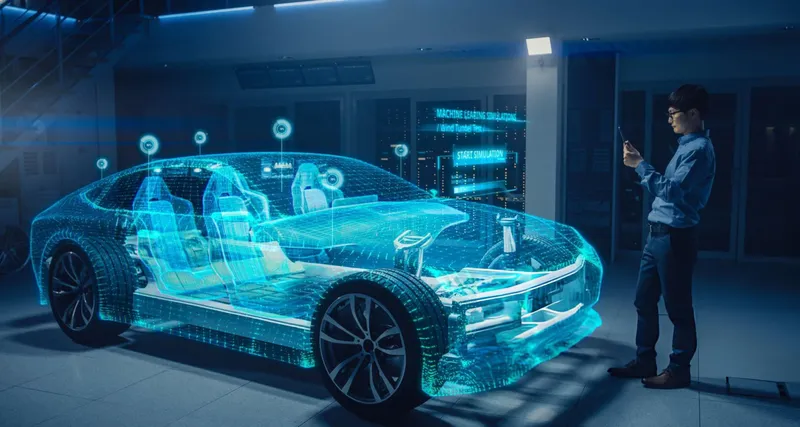
The automotive industry is undergoing its most significant transformation since the introduction of the internal combustion engine. At the heart of this revolution lies embedded systems—the software and electronics that increasingly define what a vehicle is and what it can do.
In 2026, we’re witnessing a fundamental shift from hardware-defined to software-defined vehicles, with embedded systems playing an ever-expanding role in safety, autonomy, connectivity, and user experience.
This article explores seven key trends shaping automotive embedded systems, their implications for engineers and OEMs, and how to prepare for this exciting future.
1. Software-Defined Vehicles (SDV)
The Paradigm Shift
Traditional vehicles are hardware-centric: to add features, you add physical components. Software-defined vehicles flip this model—software becomes the primary means of defining functionality, with hardware providing a flexible platform.
Key Characteristics
Centralized Computing:
- Powerful domain controllers replacing dozens of small ECUs
- Consolidation of ADAS, infotainment, body control
- High-performance processors (100+ TOPS for ADAS)
Over-the-Air Updates:
- Regular feature additions post-purchase
- Bug fixes and security patches
- Performance improvements
- New driving modes and behaviors
Feature on Demand:
- Subscription-based feature activation
- Temporary feature unlock (e.g., extra range for road trips)
- Personalization and customization
Industry Examples
Tesla: Pioneer of SDV approach
- Monthly software updates adding features
- FSD capability improvements via OTA
- Performance upgrades (acceleration, range)
Volkswagen ID Series: Traditional OEM embracing SDV
- New VW.OS operating system
- Regular feature updates
- Unified software across vehicle line
Technical Implications
For Development:
- Agile software development processes
- Continuous integration/deployment (CI/CD)
- DevOps culture in automotive engineering
- Cloud-based development and simulation
For Hardware:
- Designed for 10+ year software support
- Modular, upgradeable compute platforms
- Separation of hardware abstraction from applications
For Validation:
- Software-in-the-loop (SIL) testing
- Hardware-in-the-loop (HIL) at scale
- Over-the-air validation before deployment
- A/B testing of features
2. Zonal E/E Architecture
Moving Beyond Domain Controllers
The traditional approach organizes ECUs by function (powertrain, body, chassis). Zonal architecture organizes by physical location in the vehicle.
Architecture Overview
            Central Computer
            (High-Performance)
                  |
__________________|__________________
| | | | | Zone 1 Zone 2 Zone 3 Zone 4 Zone 5 (Front) (Front) (Center) (Rear) (Rear) Left Right Left Right Left | | | | | Sensors Sensors Sensors Sensors Sensors Actuators Actuators Actuators Actuators Actuators
Benefits
Reduced Wiring:
- Up to 30% reduction in wiring harness complexity
- Lower vehicle weight (10-15 kg savings)
- Simplified assembly
- Cost reduction
Flexibility:
- Easier to add/remove sensors and actuators
- Simplified variant management
- Faster time-to-market for new features
Scalability:
- Common architecture across vehicle platforms
- Easier upgrades and improvements
- Future-proof design
Implementation Challenges
High-Speed Networking:
- Automotive Ethernet (10G+) between zones
- Real-time requirements for safety-critical data
- Time-sensitive networking (TSN)
Power Management:
- Intelligent power distribution per zone
- Fault isolation and protection
- Low-power modes coordination
Software Complexity:
- Service-oriented architecture (SOA)
- Hypervisor for compute isolation
- Cybersecurity across zones
Industry Adoption
Lucid Air: Ethernet-based zonal architecture BMW iX: Zonal approach with central ADAS computer Mercedes EQS: Mix of domain and zonal concepts
3. AUTOSAR Adaptive and Classic Coexistence
Two AUTOSAR Standards
AUTOSAR Classic:
- Static configuration
- Hard real-time capable
- Suitable for safety-critical ECUs (brake, steering, airbag)
- Mature toolchain and ecosystem
AUTOSAR Adaptive:
- Dynamic application deployment
- POSIX-based (Linux/QNX)
- Service-oriented architecture
- Suitable for ADAS, infotainment, telematics
Hybrid Architecture
Modern vehicles run both:
Classic AUTOSAR for:
- Powertrain control
- Body electronics
- Low-level actuator control
- Brake-by-wire, steer-by-wire
Adaptive AUTOSAR for:
- Autonomous driving stack
- Sensor fusion and perception
- Vehicle-to-X communication
- Over-the-air update management
Integration Challenges
Gateway Between Classic and Adaptive:
- Protocol translation (CAN → Ethernet)
- Latency management
- Determinism guarantees
Development Tools:
- Unified modeling environments
- Co-simulation of Classic + Adaptive
- Hardware-in-the-loop for hybrid systems
Skill Requirements:
- Teams need both real-time embedded expertise and Linux/application development skills
- Bridging automotive and IT domains
4. Automotive Ethernet Dominance
Why Ethernet?
Bandwidth: CAN maxes out at 1-5 Mbps; Ethernet scales to 10+ Gbps Flexibility: Supports TCP/IP, allowing standard networking tools Scalability: Easy to add nodes and increase speeds Cost: Commodity hardware in high volumes
Current Deployment
100BASE-T1: Camera links, sensors (100 Mbps) 1000BASE-T1: ADAS ECUs, domain controllers (1 Gbps) Multi-Gigabit Ethernet: Central compute, zonal controllers (2.5-10 Gbps)
Standards and Protocols
Physical Layer:
- IEEE 802.3bw (100BASE-T1)
- IEEE 802.3bp (1000BASE-T1)
- IEEE 802.3ch (Multi-Gigabit)
Network Layer:
- SOME/IP (service-oriented communication)
- DDS (data distribution service)
- AVB/TSN (time-sensitive networking)
Time-Sensitive Networking (TSN)
Critical for mixing safety-critical and infotainment traffic on same network:
- Guaranteed latency and bandwidth
- Traffic shaping and scheduling
- Redundancy and fault tolerance
- Clock synchronization (sub-microsecond)
Design Considerations
EMC and EMI: Ethernet cables susceptible to interference in automotive environment Connector Reliability: Harsh vibration and temperature Power over Ethernet: Reducing separate power wiring Security: Ethernet increases attack surface
5. AI at the Edge
On-Board AI Acceleration
Modern vehicles include dedicated AI accelerators:
NVIDIA Drive Orin: 254 TOPS, runs ADAS and autonomous driving Mobileye EyeQ6: 38 TOPS for camera-based ADAS Qualcomm Snapdragon Ride: Scalable 10-700+ TOPS
AI Applications in Vehicle
Perception:
- Object detection and classification
- Semantic segmentation
- 3D object tracking
- Sensor fusion (camera + radar + lidar)
Prediction:
- Trajectory prediction of other road users
- Driver intent recognition
- Collision risk assessment
Planning:
- Path planning for autonomous driving
- Lane keeping and adaptive cruise control
- Parking assistance
Interior Monitoring:
- Driver drowsiness detection
- Occupant monitoring (airbag deployment)
- Gesture recognition
- Voice assistants
Development Workflow
- Data Collection: Gather real-world driving data
- Labeling: Annotate objects, lanes, behaviors
- Training: Train neural networks in cloud (days/weeks)
- Optimization: Quantize and prune models for edge deployment
- Validation: Test in simulation and on test tracks
- Deployment: OTA update or factory install
- Monitoring: Track performance, retrain as needed
Challenges
Compute Constraints: Balance accuracy vs. latency vs. power Safety Certification: Proving AI systems meet ISO 26262 Explainability: Understanding why AI made a decision (for debugging and regulation) Dataset Bias: Ensuring diverse training data representing all conditions
6. Cybersecurity by Design
The Threat Landscape
Connected vehicles face numerous attack vectors:
Remote Attacks:
- Cellular/Wi-Fi interfaces
- Bluetooth and key fobs
- V2X communication
- Cloud backend APIs
Physical Access:
- OBD-II port manipulation
- USB/SD card malware
- Hardware tampering
Supply Chain:
- Compromised components
- Malicious updates
UN R155 Regulation
Now mandatory in Europe, India following:
Requirements:
- Cybersecurity management system (CSMS)
- Threat analysis and risk assessment (TARA)
- Security by design throughout lifecycle
- Monitoring and incident response
Security Architecture
Defense in Depth:
-
Perimeter Security:
- Firewall at gateways
- Intrusion detection systems (IDS)
- Secure boot of ECUs
-
Network Security:
- Message authentication (MAC)
- Encryption (TLS, IPsec)
- Network segmentation
-
Application Security:
- Code signing
- Runtime integrity checks
- Sandboxing
-
Key Management:
- Hardware security modules (HSM)
- Public key infrastructure (PKI)
- Secure key provisioning and updates
Security Development Process
Threat Modeling: Identify assets, threats, vulnerabilities Secure Coding: Follow MISRA, CERT standards Penetration Testing: Red team exercises Bug Bounty Programs: Crowdsourced vulnerability discovery Incident Response: Plans for handling security breaches
Example: OTA Security
Secure over-the-air updates require:
- Authentication: Verify update source
- Integrity: Check digital signatures
- Confidentiality: Encrypt sensitive updates
- Rollback Protection: Prevent downgrade attacks
- Safe Fallback: Revert if update fails
7. ISO 26262 for AI and Complex Systems
Functional Safety Evolution
ISO 26262 was designed for deterministic systems. AI and SDV bring new challenges:
Non-Deterministic Behavior: AI outputs aren’t fully predictable Complexity: Millions of lines of code, deep neural networks OTA Updates: Safety validation post-production
SOTIF (ISO 21448)
Safety of the Intended Functionality addresses:
- Limitations of sensor performance
- Scenarios not covered in design
- Foreseeable misuse
- Validation of intended functionality
Approaches for AI Safety
Redundancy and Diversity:
- Multiple sensor modalities (camera + radar + lidar)
- Diverse AI models (different architectures)
- Fallback to non-AI systems
Runtime Monitoring:
- Plausibility checks on AI outputs
- Confidence scores and uncertainty quantification
- Safe state transition if anomaly detected
Simulation and Validation:
- Billions of simulated miles
- Corner case generation
- Automated test case generation
Explainable AI:
- Saliency maps showing what AI “sees”
- Decision trees for critical functions
- Logging for post-incident analysis
Certification Challenges
For OEMs:
- Demonstrating sufficient validation
- Defining operational design domain (ODD)
- Continuous validation for OTA updates
For Suppliers:
- Safety element out of context (SEooC) approach
- Safety manual for integration
- Tool qualification (e.g., AI training platforms)
Practical Implications for Engineers
Skills to Develop
Software Skills:
- Linux kernel and real-time OS
- Networking protocols (Ethernet, TCP/IP)
- Machine learning fundamentals
- Cybersecurity principles
- DevOps tools (Git, CI/CD)
Standards Knowledge:
- AUTOSAR (Classic and Adaptive)
- ISO 26262 and SOTIF
- UN R155 (cybersecurity)
- Automotive SPICE
Communication Protocols:
- CAN, CAN FD, CAN XL
- LIN, FlexRay
- Automotive Ethernet (100BASE-T1, 1000BASE-T1)
- SOME/IP, DDS
Tools and Platforms
Development:
- Vector CANoe, CANalyzer
- dSPACE SystemDesk (AUTOSAR)
- MATLAB/Simulink (model-based design)
- Lauterbach debuggers
Testing:
- Vector VT System (HIL)
- National Instruments HIL
- IPG Automotive (driving simulation)
- CARLA, LGSVL (open-source simulation)
Debugging:
- Logic analyzers (CAN, Ethernet)
- Protocol analyzers
- JTAG debuggers
- Network packet capture tools
Career Paths
Embedded Software Engineer: Focus on AUTOSAR, ECU development ADAS Engineer: Sensor fusion, perception, control algorithms Cybersecurity Engineer: Threat modeling, penetration testing Safety Engineer: ISO 26262, SOTIF, validation DevOps Engineer: CI/CD pipelines, OTA infrastructure
TEK DEPO Solutions for Automotive Development
We provide essential tools for automotive embedded engineers:
CAN Bus Development Kits
Our self-learning kits include:
- Hardware for CAN, CAN FD
- Example code and tutorials
- Real-world automotive scenarios
- Support for major MCUs (STM32, NXP, Infineon)
Protocol Converters
Bridge automotive and PC/IT interfaces:
- CAN to USB (for logging and analysis)
- CAN to RS485 (for industrial integration)
- CAN to Ethernet (for testing zonal architectures)
Gateways and Routers
Test and develop networking solutions:
- Multi-protocol gateways
- Ethernet switches with TSN
- Wireless connectivity (4G/5G, Wi-Fi)
Training and Consulting
Expert guidance on:
- AUTOSAR architecture and implementation
- CAN/Ethernet protocol development
- Functional safety (ISO 26262)
- Cybersecurity (UN R155)
Conclusion
The automotive embedded systems landscape in 2026 is characterized by unprecedented change and opportunity. Software-defined vehicles, zonal architectures, AI at the edge, and stringent safety and security requirements are reshaping how vehicles are designed, developed, and maintained.
For engineers, this means exciting new challenges and the need for continuous learning. The convergence of automotive and IT domains creates opportunities for those who can bridge both worlds.
Success in this environment requires not just technical skills, but also understanding of standards, safety, and the broader automotive ecosystem. Partner with experienced providers, invest in the right tools, and never stop learning.
The vehicles of 2030 will be vastly different from those of 2020—and the engineers developing them today are creating that future.
Ready to level up your automotive embedded skills? Explore our CAN bus self-learning kits and automotive development tools. Contact us for expert guidance on your next project.