
Introduction
Cars today are no longer just mechanical machines. They are networks on wheels.
Behind every dashboard alert, battery status update, braking command, or diagnostic scan lies a silent workhorse that has survived decades of automotive evolution — the CAN Bus.
Despite the rise of Automotive Ethernet, software-defined vehicles, and connected mobility, CAN Bus remains deeply embedded in both internal combustion vehicles (ICE) and electric vehicles (EVs). The question isn’t why hasn’t CAN disappeared?
It’s why CAN still works — and why it still matters.
A Protocol Built for the Real World
Controller Area Network (CAN) wasn’t designed in a lab for ideal conditions. It was designed for:
- Electrical noise
- Real-time constraints
- Multiple ECUs talking simultaneously
- Safety-critical communication
That rugged DNA is exactly why CAN became — and remains — the backbone of automotive electronics.
From engine control units and braking systems to battery management and body electronics, CAN handles communication where failure is not an option.
In automotive systems, “fast” is good — but deterministic and reliable is essential. CAN delivers that balance.
CAN in the Age of Electric Vehicles
A common misconception is that EVs are leaving CAN behind. In reality, EVs depend on CAN more than ever.
Modern EV platforms use CAN extensively for:
- Battery Management Systems (BMS)
- Thermal management
- Motor controllers
- Diagnostics and fault reporting
- Vehicle control units (VCUs)
Even when higher-bandwidth protocols are introduced, CAN continues to serve as the control and safety backbone, while other networks complement it.
In short:
Ethernet adds capability. CAN ensures reliability.
Why Industry Still Trusts CAN
Automotive suppliers and OEMs continue to rely on CAN because it offers:
- Mature tooling and diagnostics
- Predictable timing behavior
- Built-in error detection
- Low implementation cost
- Global standardization
For engineers, CAN is often the first protocol they touch when entering automotive or embedded roles — and the one they return to when systems must work without surprises.
The Hidden Gap: Theory vs Real CAN Experience
Here’s the challenge we see across engineering education and early careers:
Many curricula introduce CAN theoretically.
Hands-on exposure depends on institutional initiative.
Students may learn CAN frames, arbitration, and IDs on paper — but never:
- Configure a CAN node
- Observe real arbitration
- Debug bus errors
- Decode live messages
- Interface ECUs and tools
This gap shows up immediately in industry, where engineers are expected to work with real CAN traffic from day one.
Why Practical CAN Skills Still Define Automotive Readiness
Recruiters and technical leads don’t just ask:
“Do you know CAN?”
They ask:
- Have you worked with real CAN hardware?
- Can you debug a noisy bus?
- Can you interface tools, ECUs, and sensors?
- Can you interpret diagnostics data?
Practical CAN knowledge shortens onboarding time and builds confidence — whether the role is in:
- Automotive electronics
- EV systems
- Embedded software
- Diagnostics and testing
- Industrial vehicle platforms
From Learning to Industry Enablement
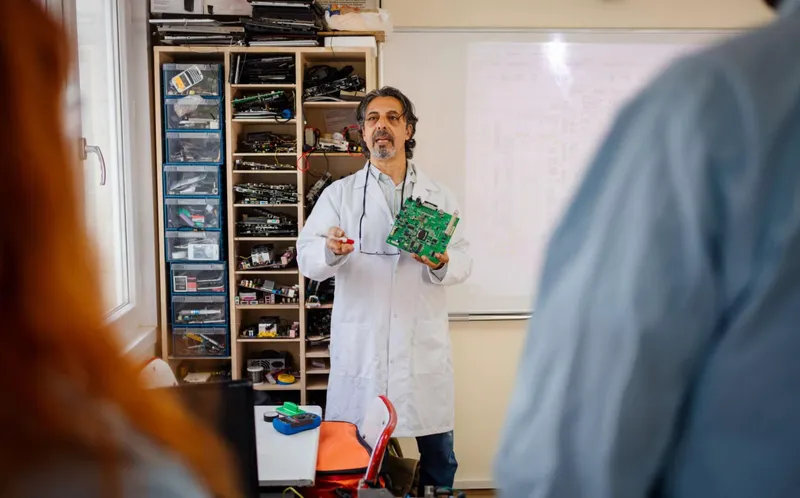
At TEK DEPO, we see CAN not as an academic topic, but as a foundational industry skill.
That’s why our focus is on:
- Turning syllabus concepts into real lab outcomes
- Enabling institutions to initiate hands-on CAN learning
- Supporting engineers, R&D teams, and labs with practical tools
When learners interact with real CAN networks — not simulations alone — confidence replaces confusion.
Final Thoughts
Technologies evolve. Architectures expand. Vehicles become smarter.
Yet CAN Bus continues to quietly do what it was designed to do — connect systems reliably, in real time, under pressure.
For students, engineers, and institutions preparing for the future of mobility, understanding CAN isn’t optional.
Mastering it — practically — is the real advantage.
CAN may not be the newest protocol on the road, but it remains the one every serious automotive engineer must understand deeply.